
Note: Paid subscribers can download all four complete lesson packages at the end of the post.
Six months ago I shared my first benchmarks for Claude, ChatGPT and Gemini for ESL lesson creation. A lot has changed. Some things have not.
I use Claude most, so I’m biased. These are personal impressions from my process.
My method: I build complete lesson packages on contemporary topics — ten to thirteen exercises each, delivered as PDF worksheets and audio files. Some of the problems below are invisible in the workflow. They only show up in class.
Claude is the workflow specialist. Nearly every lesson I make now is built with skill files — reusable instruction files for each worksheet type. Claude follows them, runs the long multi-step builds, and packages the finished lesson into one zip file. It has no image generation, so I supply my own pictures.
Gemini is the multi-modal specialist. Fast and versatile: speech-to-text transcripts, quick images, NotebookLM for research and audio overviews. But the features are scattered across different apps; it often breaks down after one or two instructions, and it still can't make a zip file.
ChatGPT sits between the two, trying to combine both. Its image generation has improved a lot — flexible, varied, easy to edit by chatting. I can’t judge its lesson-building workflow fairly; keeping up with Claude takes enough of my time.
Examples of failures:
1. Randomisation. The old problem: multiple-choice answers clustered on B and C. Mostly gone. The new problem: answers fall into a repeated pattern — B, C, D, A, B, C, D, A. Harder for students to spot, but still not random. Word banks drift the same way — asked to shuffle, they come back barely changed.
2. Sorting. Asked to sort vocabulary into categories, it forces a word into a box to make the sort look complete, instead of flagging it as a poor fit or leaving it out.
3. The giveaway answer. Accuracy errors — two correct answers, or a key that doesn’t match the exercise — are rare now. Instead, the correct answer is often the longest one. Over repeated exams, students might notice.
4. Missing features. Gemini’s workflow problem. Not disobedience — features like zip downloads and easy file conversion just aren’t there.
All four need checking, but in different ways. Knowing which failure you’re looking at tells you whether to re-prompt, proofread, or switch tools.
Google knows
After months of these Gemini problems, I thought: Google doesn’t care about this at all. Then Google’s CEO confirmed it. On the Hard Fork podcast, just after Google I/O, Sundar Pichai admitted Google is “a bit behind” on agentic coding — tool use, instruction following, and long multi-step tasks.
New models break old workflows
The newest model is the most capable and the least predictable. When I moved to the latest Claude model, layouts that had been stable for months came out wrong. Old problems returned: unshuffled word banks, vocabulary forced into the wrong sorting categories.
Skill files hold my instructions, but each model interprets them differently. So you have to re-test and re-flag some old problems.
Failures become process
Here’s the useful part: the failures usually lead to something new. Vocabulary kept drifting above the target level, so I built a multi-level skill that makes a matched Intermediate version alongside the Pre-Intermediate one. The answer keys were chaotic, so a PDF answer-key skill now produces a clean one every time.
Today’s four packages came out of exactly that process.

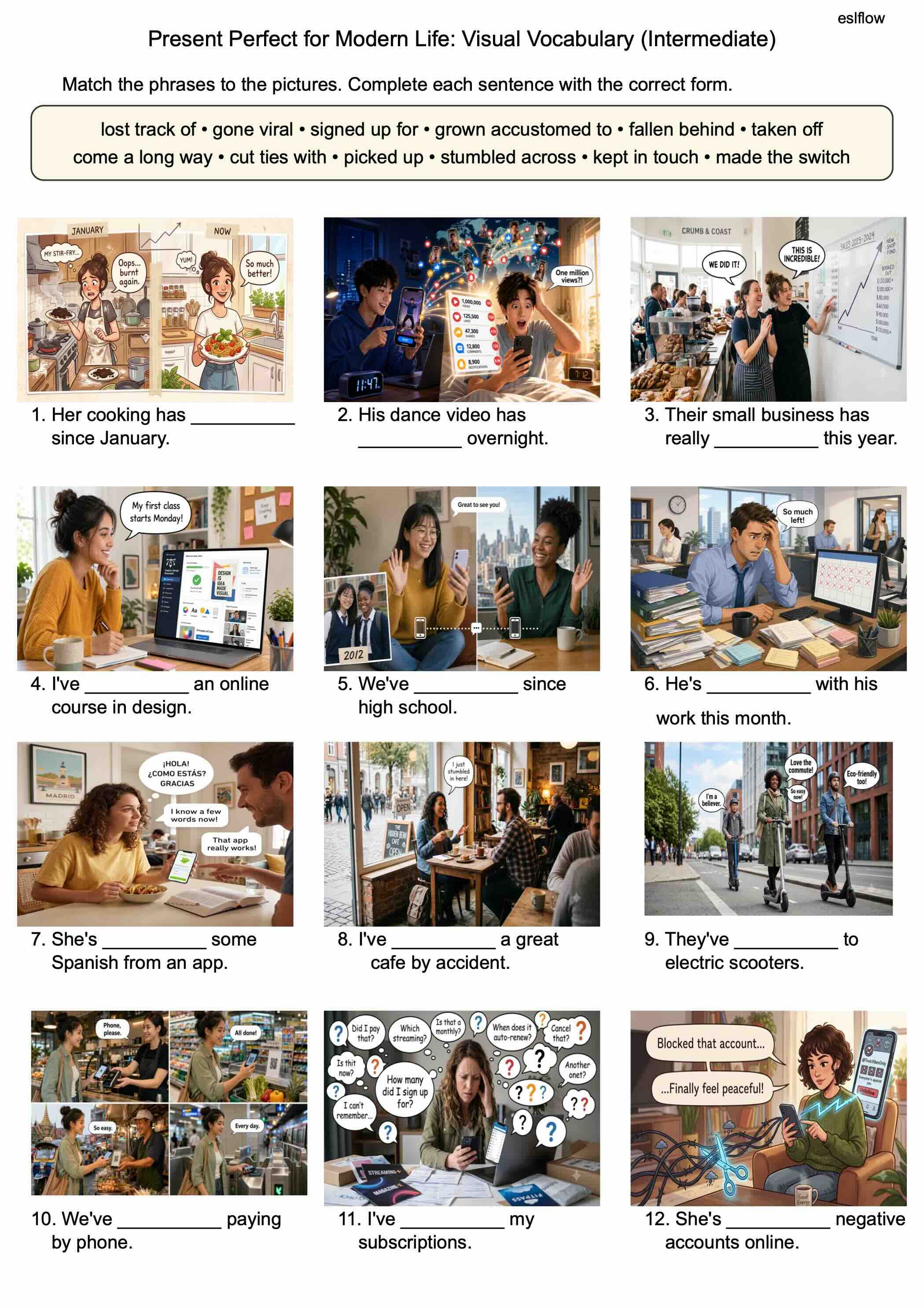
Present Simple & Present Perfect for Modern Life — Intermediate (new)
Two brand-new grammar packages, and the multi-level skill at work: each is the Intermediate (B1–B2) half of a matched pair, built to sit alongside its Pre-Intermediate version.
But “grammar lessons” undersells them. Both are really about how we live now. Present Simple: Modern Life runs on the everyday verbs of a crowded week — juggle, squeeze in, stick to a routine, unwind, cut down on, swear by — and the exercises are pure 2026: a combo chart comparing screen time against exercise across age groups, a critical-thinking set on digital wellbeing, convenience-versus-privacy and the always-on lifestyle, and a schedules-and-timetables role play that folds in embedded questions. Present Perfect: Modern Life takes the “how far we’ve come” angle — gone viral, taken off, made the switch, grown accustomed to, kept in touch, fallen behind — and uses it to talk about reinvention, online friendship and burnout, closing with a graph on the rise of streaming against cable and a ten-years-later school-reunion speaking activity. The Present Perfect package also splits simple against continuous in a dedicated role play, so the trickiest contrast in the tense gets its own workout.
Both are full W1–W12 packages: brainstorm, visual vocabulary, a discussion-quiz listening, a dialogue and a lecture, vocabulary, collocation and word-formation review, opinion completion, critical thinking, a grammar role play, pronunciation linking-and-emphasis, a graph-reading page and a picture-based talk zone.
Streaming TV — rebuilt (pre-intermediate)
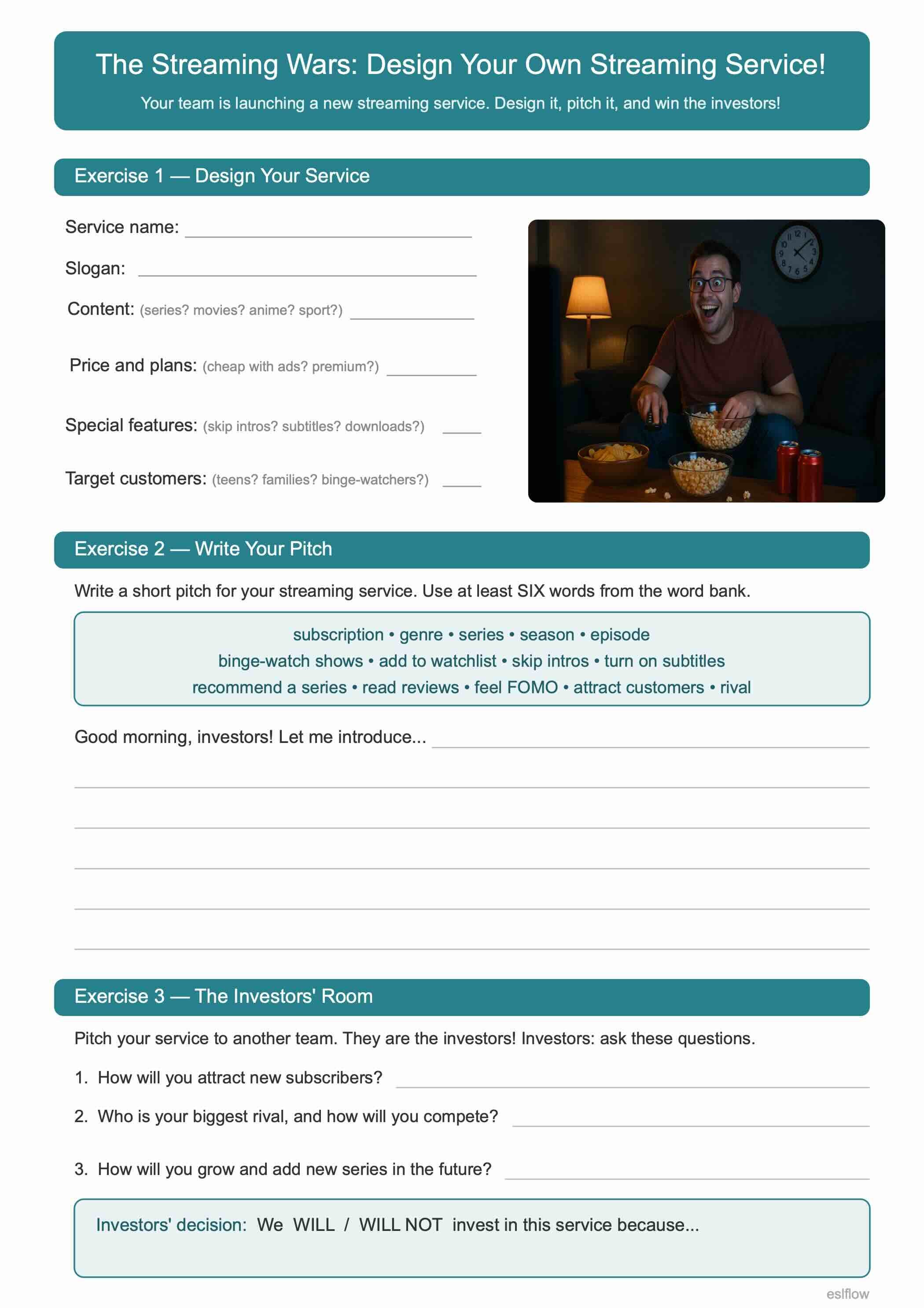
A full makeover of the Streaming package: reorganised exercises, tidied format, and a cleaned-up answer key with the multiple-choice balance actually checked rather than assumed. It runs W1–W13 on the vocabulary of how we watch now — binge-watch, watchlist, subtitles, FOMO, genre, subscription — through a revised dialogue, opinion and critical-thinking pages, a polite-requests customer-support role play, a graph on binge-watching by age, and a W13 “Streaming Wars” project where teams invent and pitch their own streaming service to a room of investors.
The Air I Breathe — reading, writing & critical thinking (pre-intermediate to intermediate)
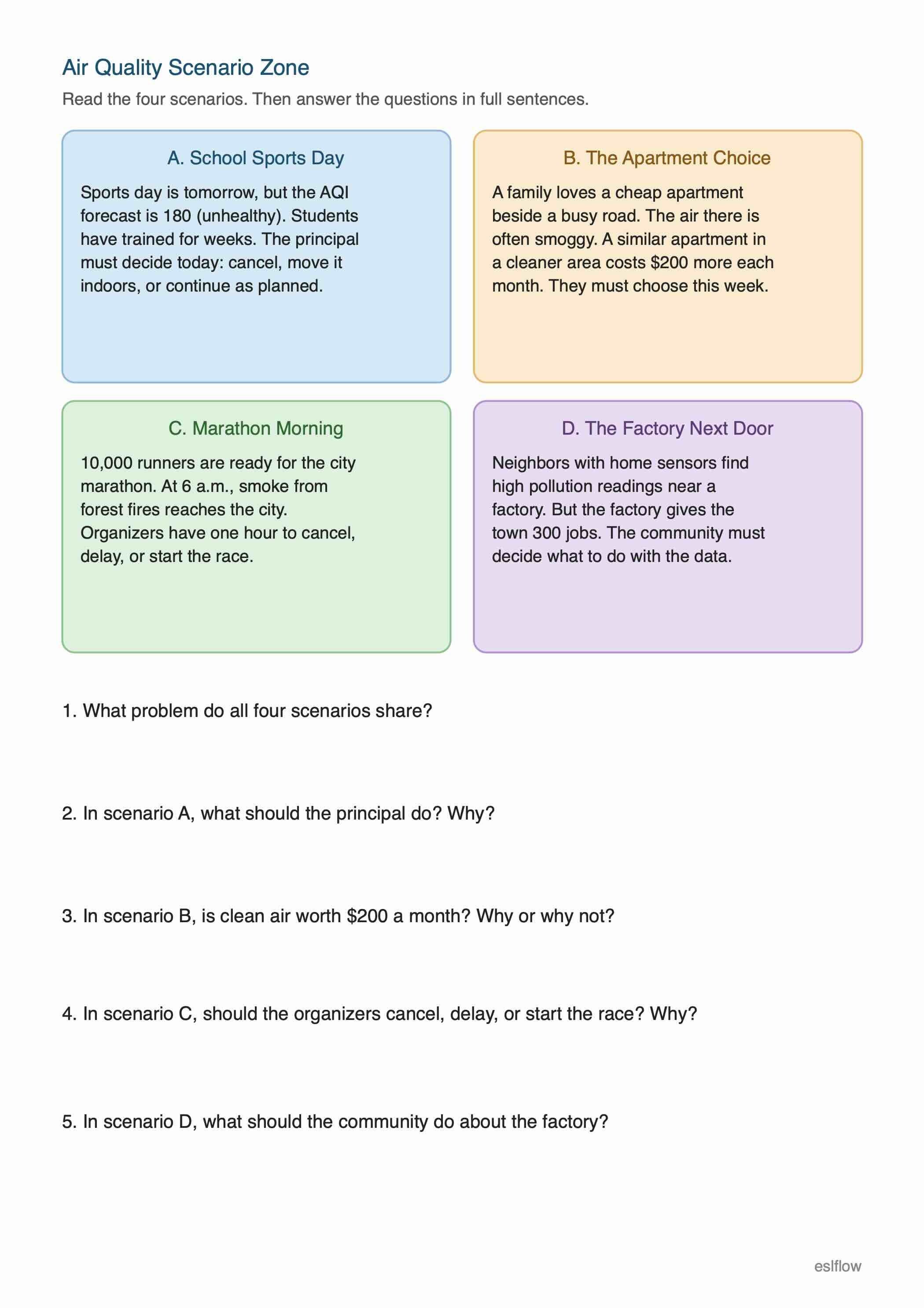
This one runs on the RW1–RW13 flow — my reading/writing and critical-thinking lesson sequence, the reading parallel to the W1–W12 system — and it’s had the full clean-up: reorganised exercises, tighter format, a corrected answer key. It’s built around a real citizen-science story — cheap homemade sensors, seven million premature deaths a year, the campaign for clean air as a legal right — so the comprehension page has actual people and numbers to scan for, not invented ones. It closes strong: a “Scenario Zone” of genuine trade-offs (cancel sports day or move it indoors? pay $200 more for an apartment with clean air?) and a scaffolded paragraph-writing task with a marking rubric.
The reality check
None of this is finished until it’s been taught. AI can be handed the templates, the prompts and the exemplars, but what actually works with a particular group of learners in a particular room is something you still only learn by teaching.
