
Note: Paid subscribers can download all seven complete lesson packages at the end of the post.
Exercise and lesson creator? Not any more. Content designer — and the job now looks more like making a film than writing a worksheet.
Pre-production comes first. A course outline, a module outline, a list of vocabulary the whole lesson will recycle, and a mockup — the storyboard — before anything is produced.
Then the shoot. The script: conversations, readings and exercises. The sound: audio scripts with cues for emotion and emphasis, recorded with a cast of voices. The visuals: pictures found, pictures made, charts and maps. The set: layout, page by page.until
Then post-production. Checking, cutting, answer keys, and an easier and a harder cut of the same lesson. Then the release: the student binder, the contents page — and this post, the trailer.
Like any film, it has to connect with its audience. The right level. An awareness of cultural nuances. A range of skills, from pronunciation and grammar to listening, speaking and critical thinking. Different ways in for different learners. Vocabulary that keeps coming back. Scaffolding, so each scene sets up the next. A topic people care about now.
The four lessons below are eight pages each, from vocabulary to conversation, language practice and pronunciation, listening, reading and speaking, scaffolded so the lesson flows. Words and word partners first. Then a model conversation followed by a skeleton for students to fill with their own ideas. Each lesson focuses on a specific grammar point. By the last page they're talking on their own.
Sometimes the release date does something nobody planned. The art and museums lesson includes a reading about the famous artist Yayoi Kusama. She died in August, just over a month ago, aged 97.

It Was Painted by Kusama — Art and Museums, Passives
New, pre-intermediate (A2–B1). Vocabulary runs from murals and pottery to immersive art, AI art and latte art. The listening is a tour of three museums — teamLab Borderless, the Museum of the Future and the Louvre Abu Dhabi — with the new Grand Egyptian Museum in Listening Plus. The reading, “A Life Covered in Dots”, follows Kusama from Matsumoto to New York to the pumpkin a typhoon washed away. The Talk Zone asks the question every gallery visitor asks: one blue line on a white canvas, $50,000 — is it really art?

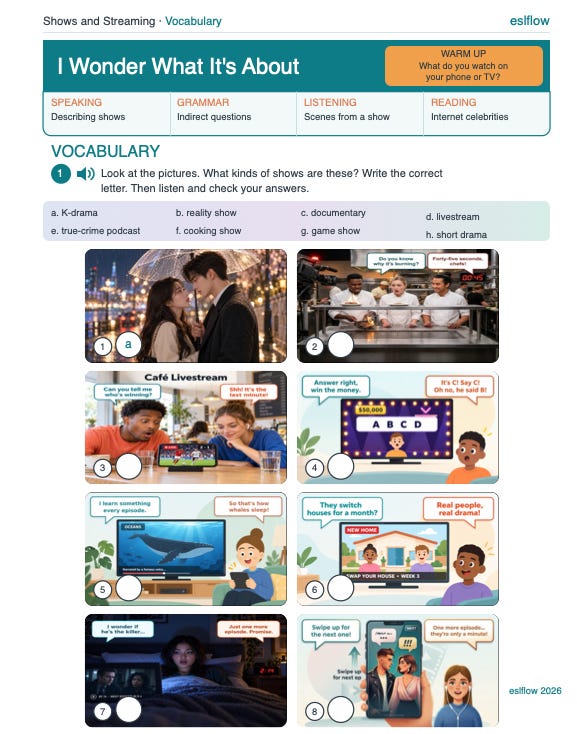
I Wonder What It’s About — Shows and Streaming, Indirect Questions
New, pre-intermediate. K-dramas, short dramas, livestreams, true-crime podcasts and cooking shows. The listening is a three-scene mystery, “Secrets at the Café”; the reading compares Khaby Lame and Li Ziqi; the pronunciation page works on d’ya know and c’n you tell me.
What Have You Been Up To? — Hobbies and Free Time, Present Perfect Continuous
New, pre-intermediate. Run clubs, blind-box toys, matcha, Pilates, pickleball, wild swimming and second-hand clothes — the things students have actually been doing lately. The reading takes a day at the drone races.
Gotta Have It! — Wearables and Gadgets, Infinitives and Gerunds of Purpose
New, pre-intermediate. Smart rings, smart glasses, foldable phones, VR headsets and the power bank everyone wants at the airport. The listening is three gadget reviews — a waterproof fitness band, translation earbuds and a smart tag (used to find a cat). The reading covers the NBA’s Oura rings and Be My Eyes on Ray-Ban Meta glasses; the pronunciation page is gotta.
Personality — Listening/Speaking and Reading/Writing
Pre-intermediate. The listening/speaking package is updated with a new Digital Life listening quiz and a topic survey. The reading/writing package is new: personality at work and in international teams, with a short reading on five-minute personality tests, an article called “Quiet Power”, a scenario zone and a personality quiz. The writing is scaffolded: students sort their ideas in a paragraph planner first, and weaker classes get a gap-fill version of the paragraph.
Cross-Cultural Communication in Science — Reading/Writing
Pre-intermediate, for medical science research students. Working in an international lab, doing research with communities, and sharing science across borders. The article tells the Havasupai blood-samples case; the bar chart uses real data on which countries write science papers together. The same paragraph planner and gap-fill paragraph scaffold the writing.
