
Note: Paid subscribers can download all six complete lesson packages at the end of the post.
I’m compiling lesson flows. There are four so far.
The first is the W1–W13 package — a listening and speaking lesson as a set of worksheets: brainstorm, picture vocabulary, discussion quiz, dialogue, collocations, critical thinking, role play, pronunciation, a chart, a Talk Zone, a design-your-own project. The second is its reading and writing twin, RW1–RW13, with articles, a paragraph planner and a gap-fill paragraph in place of the listening and role play. The third is an eight-page four-skills unit — vocabulary, conversation, language and pronunciation practice, listening, reading, speaking — one topic, one grammar point, seven audio tracks. The fourth is the test prep sequence, T1–T6. It does two jobs at once: an intensive vocabulary and grammar lesson on the topic — picture vocabulary, a vocabulary quiz, a grammar focus page, listening and reading exercises — and a lesson in how test formats work: the types of talk, the question and response, the photo question, the reading passage. It ends in a mini-test.
Four flows, but many components are interchangeable. For example, the picture vocabulary page can be used in any of the lesson flows, and others can be swapped in and out depending on the topic, student level, class size or atmosphere, and a whole host of other variables.
This is only the start. I’ve been going back through old lesson sequences, unit by unit, to mine them. Some components are worth remaking — a grammar sequence, a listening format, a pronunciation exercise format. Some aren’t. The best can be rebuilt in an updated style, with this year’s topic, and then fine-tuned.
That’s modular lesson design. A lesson isn’t a fixed sequence any more. It’s a series of components that fit together in more than one lesson flow. It can be adapted to a class’s needs. Or, maybe, you just get bored with one lesson sequence. So you can just jump to an entirely new one — for variety, a fresh atmosphere and to explore new ideas.
Here are some examples: one topic, Immersive Worlds, built in two different flows, and four eight-page units remade from an old lesson sequence.

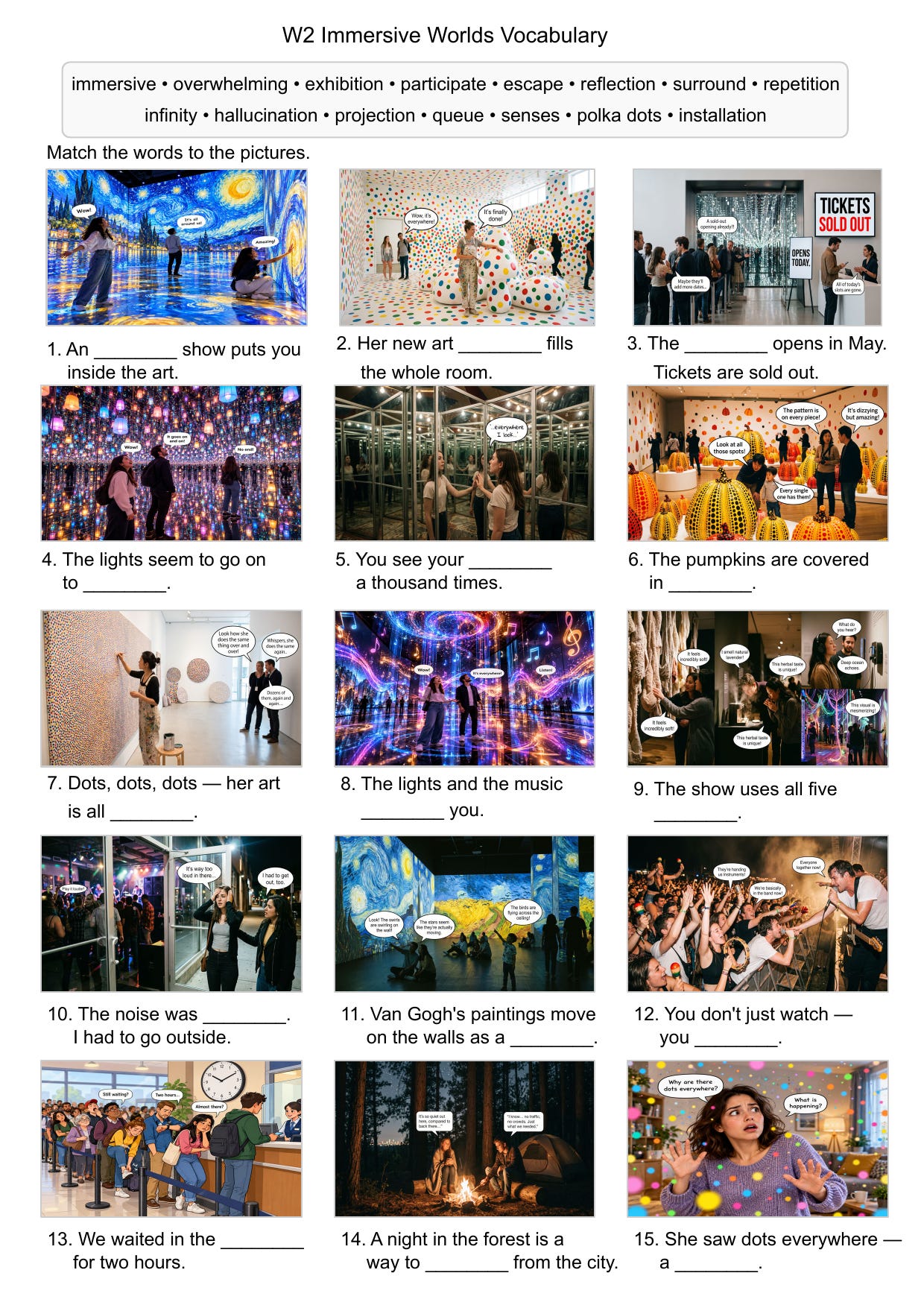
Immersive Worlds — Listening/Speaking (W1–W13) and Reading/Writing (RW1–RW13)
Pre-intermediate, two packages, one topic. Last release had a reading about Yayoi Kusama. This time she has the whole lesson: mirror rooms, polka dot pumpkins, teamLab, Van Gogh on the walls — and the question of whether a selfie museum is art at all. Both packages share the brainstorm, the picture vocabulary, the three critical thinking pages and the bubble chart. From there they go different ways. The listening/speaking package has a discussion quiz, a dialogue outside the mirror room, a present perfect role play at the ticket desk, pronunciation, a Talk Zone with pictures, and ends with The Immersive Wars — groups design their own experience and pitch it to a room of investors. The reading/writing package has a short reading quiz, an article on the woman who invented the immersive experience, the paragraph planner and the gap-fill paragraph for weaker classes.
It Must Have Been a Deepfake — Fact or Fake, Modals of Deduction
New, pre-intermediate (A2–B1). Deepfake, rumour, scam, clickbait, conspiracy theory, hoax, fact-check; students sort words into true, might be fake and fake. The listening is a “Real or Fake?” podcast — lights over a river, a snake in a supermarket, a voice message that wasn’t from the person it sounded like. The reading, “Hoaxbusters”, takes the Pope’s white puffer jacket, the shark that appears after every big storm, and the Glasgow chocolate-factory event that turned out to be a nearly empty warehouse and two jelly beans. The pronunciation page is musta, mighta, coulda. The Talk Zone: a floating castle, a 500-year-old phone, the perfect reviews.
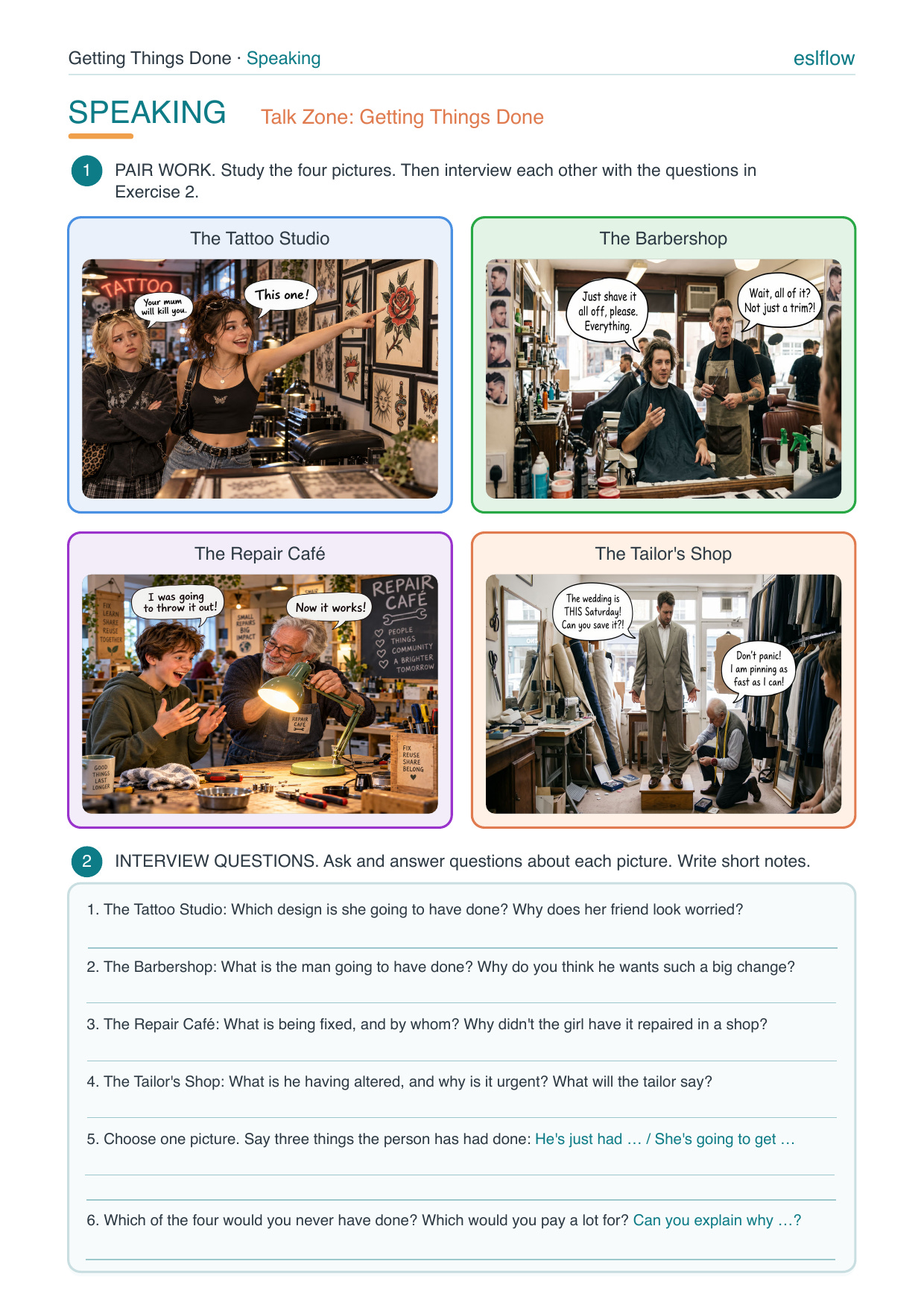
Where Did You Get That Done? — Getting Things Done, Have / Get Something Done
New, pre-intermediate. Hair dyed, a screen repaired, a tattoo done, a car serviced, a jacket altered, teeth whitened. The listening is “New Look, Big Mistake” — a cheap repair that didn’t last, a tattoo with a surprising meaning, hair the wrong colour. The reading goes to Amsterdam, where a journalist started the first repair café — free, and now thousands of them. The Talk Zone cards are the barbershop, the tattoo studio, the tailor’s shop and the repair café.
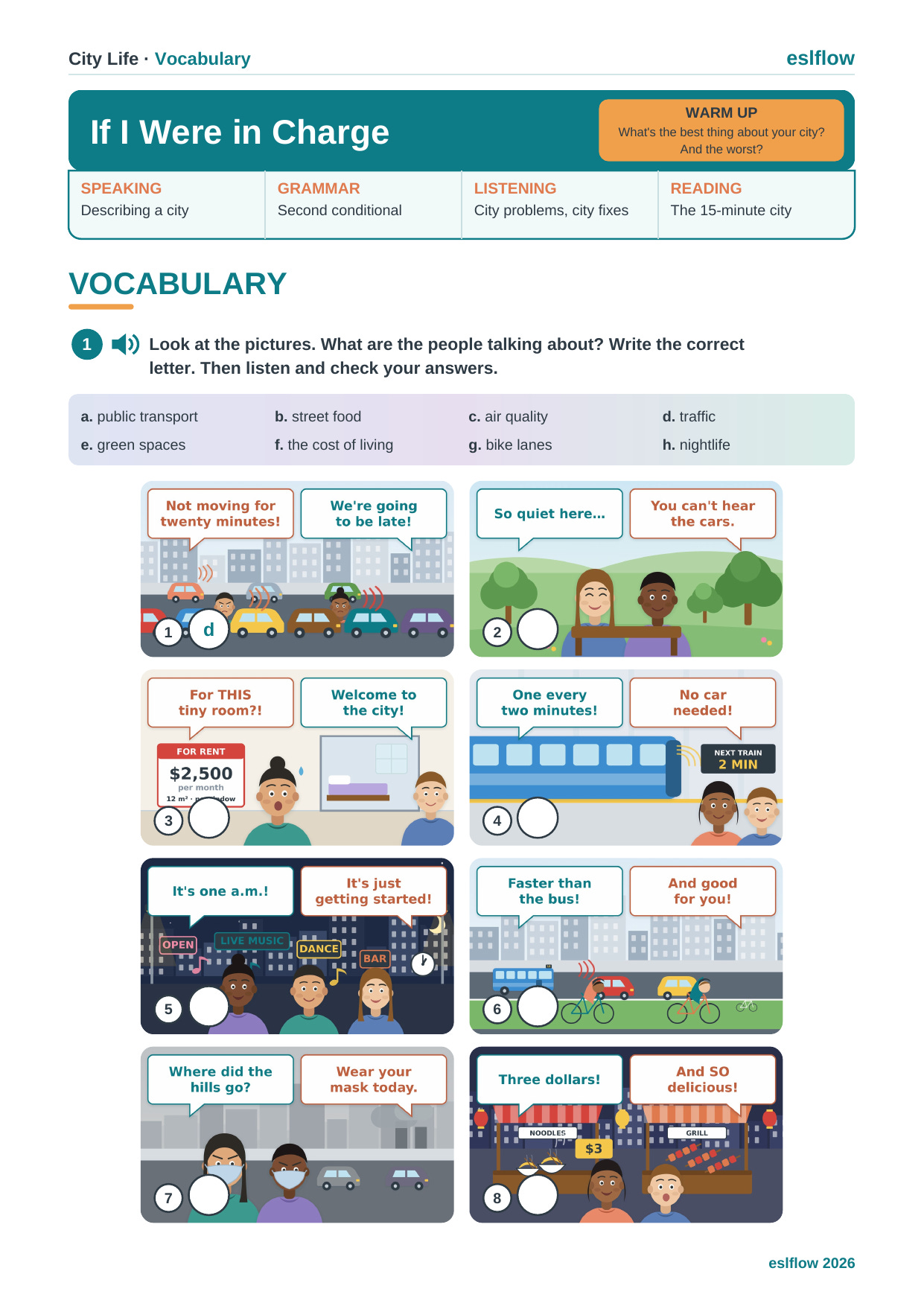
If I Were in Charge — City Life, Second Conditional
New, pre-intermediate. Traffic, green spaces, the cost of living, air quality, nightlife, bike lanes. The listening is a “What’s Your Problem?” phone-in — a bus that stopped coming, weekend parties in the holiday flat next door, an exercise class upstairs at six. The reading asks “Could You Live in a 15-Minute City?” and follows what Paris has actually done: thousands of parking spaces removed, streets near schools closed to cars, 300 streets turned green. The pronunciation page is wouldja.
He’d Never Taken a Flight — Travel Stories, Past Perfect
New, pre-intermediate. The vocabulary page is people under pressure — exhausted, careless, in a hurry, nervous — and the adverbs that come from them. The conversation is a typhoon, a missed last train, a two-hour walk and a capsule hotel bed given to someone else. The listening is “Travel Nightmares” — three callers, a car stuck in the snow, a board full of cancelled flights. The reading is the Danish man who visited every country in the world without taking a single flight: four years planned, nearly ten taken, 37 container ships, malaria, and a wedding along the way.
