
Note: Paid subscribers can download all six complete lesson packages at the end of the post.
Quick commerce is one of the core features of the new economy. You place an order for milk and bread, and a rider on a scooter is at your door in ten minutes. Behind that is a logistics network — dark stores, small warehouses closed to the public, and thousands of gig workers. Behind that is a start-up business model: burn cash on discounts, win market share, and hope your pockets are deeper than your rivals’. Most of these companies still don’t turn a profit.
This release has a new lesson on quick commerce at two levels, a new lesson on running a start-up, and a makeover of Spatial Computing.

Quick Commerce — Ten Minutes or Less
A completely new lesson, built at two levels, each with a listening/speaking package and a reading/writing package — four in all.
It’s filed under business English, but it’s really about who pays for convenience. The opening discussion brings together a customer who loves the apps, a sceptic who thinks nobody needs oranges in twelve minutes, a student who rides at weekends, and a corner-shop owner who can’t compete with free delivery. The critical thinking exercises explore the different sides of quick commerce: the rider’s safety and pay, the corner shop’s future, and whether a business that loses money on every discount can survive. The reading is adapted from a report on India’s fast-delivery battle, where Amazon arrived late and is now spending $3 billion to catch up.
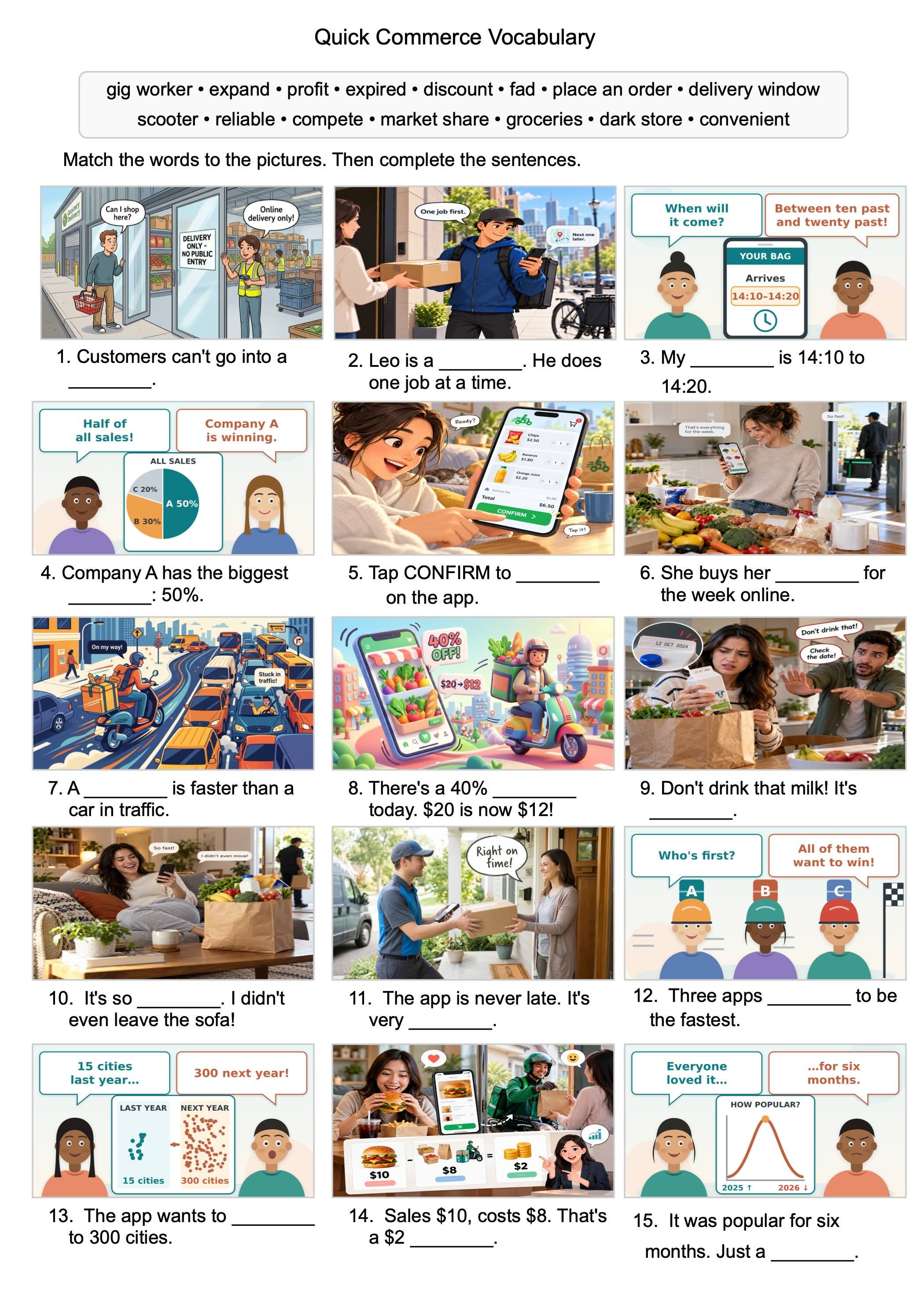
Pre-intermediate — vocabulary includes dark store, gig worker, delivery window, expired, reliable and fad. Students rank who really needs a delivery in ten minutes, look inside a dark store, practise the first conditional in a role play, and design their own delivery app.
Intermediate — the vocabulary moves up to burn cash, deep pockets, muscle in on, under scrutiny, overhyped and consolidation. This level adds a short lecture, Can Quick Commerce Ever Make Money?, a reported speech role play, a combo chart, and a debate on whether the riders’ deal is a free market or exploitation. The Talk Zone, The 10-Minute City, works well at both levels.
Spatial Computing — AR and VR in Everyday Life
A makeover of an older lesson, built around AR and VR as students already use them: GPS navigation, social media filters, and seeing furniture in your room before you buy it. The survey has a small surprise in it: a face filter is augmented reality. Vocabulary includes haptic feedback, digital twin, overlay and track movement. There’s a future forms role play about redesigning a store layout, a bar chart on how people use AR and VR, and a group project — The Reality Wars: Design Your Own AR App. (Pre-intermediate and above.)
Running a Start-Up — Test Prep
A new test-prep lesson in six parts. Two pages of visual vocabulary take students from co-founder, crowdfunding and prototype to pivot, saturated and broke even. There’s a grammar focus on the future perfect, a set of business idioms (throw in the towel, back to the drawing board, cut to the chase, see eye to eye), a reading strategy page built on memos and launch-day ads, and a full mini-test with photographs, question-response, conversations and short talks. (Pre-intermediate.)
