Note: Paid subscribers can download all 7 complete lesson packages at the end of the post.
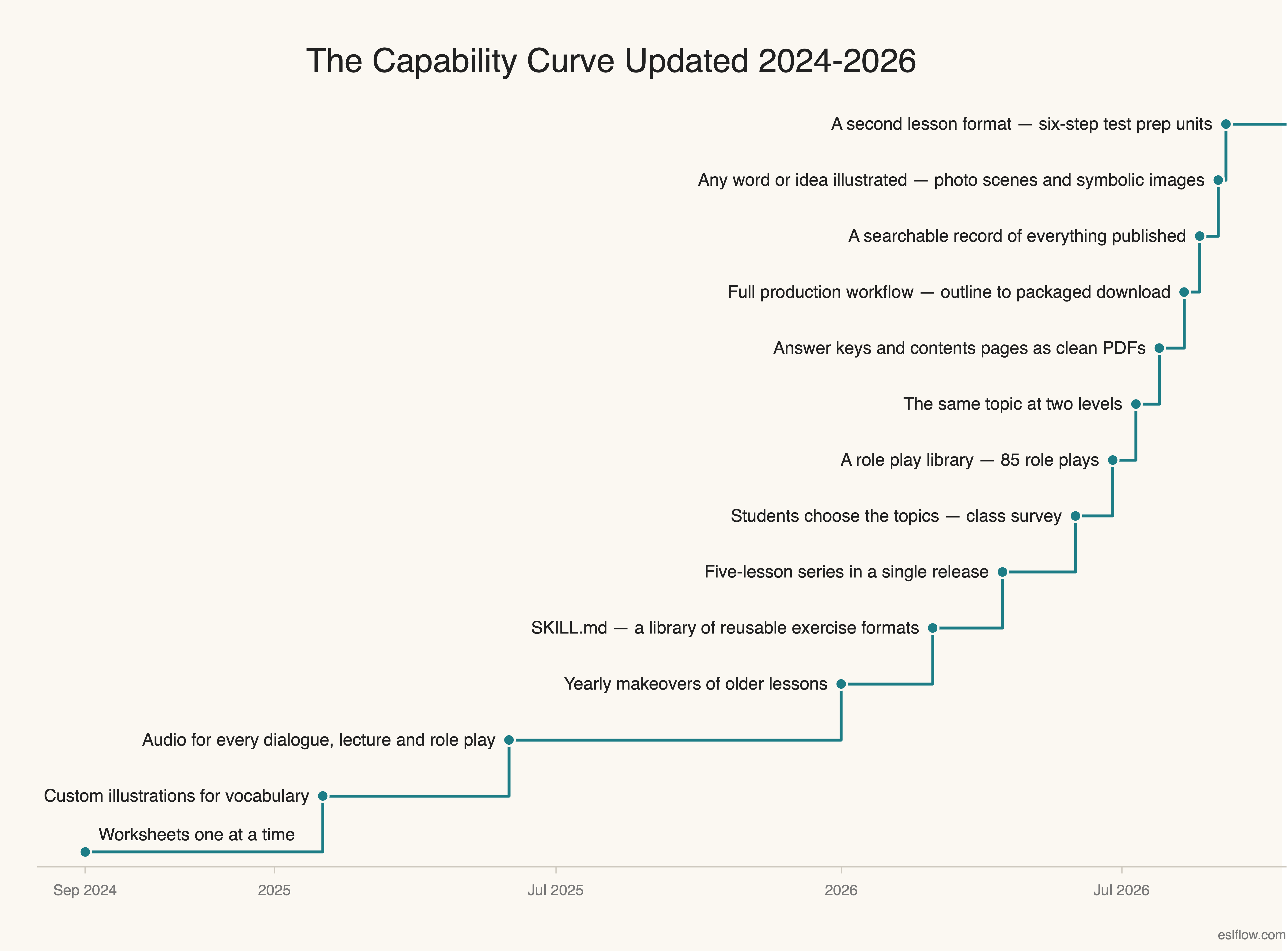
A few weeks ago I wrote about the capability curve — the things I can now do as a matter of routine that two years ago I did one worksheet at a time. This post is the curve a month later.
New content. Forensic science used to mean crime shows. Now it runs through medical science, toxicology, public health and digital investigation, and students will meet it whatever they are studying. These reading/critical thinking/writing lessons, at pre-intermediate and intermediate, explore the language, the ideas and a range of scenarios: the crime scene and the first DNA case, disease detectives tracing an outbreak, who can see your DNA, and the tsunami victim identification operation in Phuket — 3,750 bodies, 300 investigators from 30 countries, one of the biggest forensic operations in history.
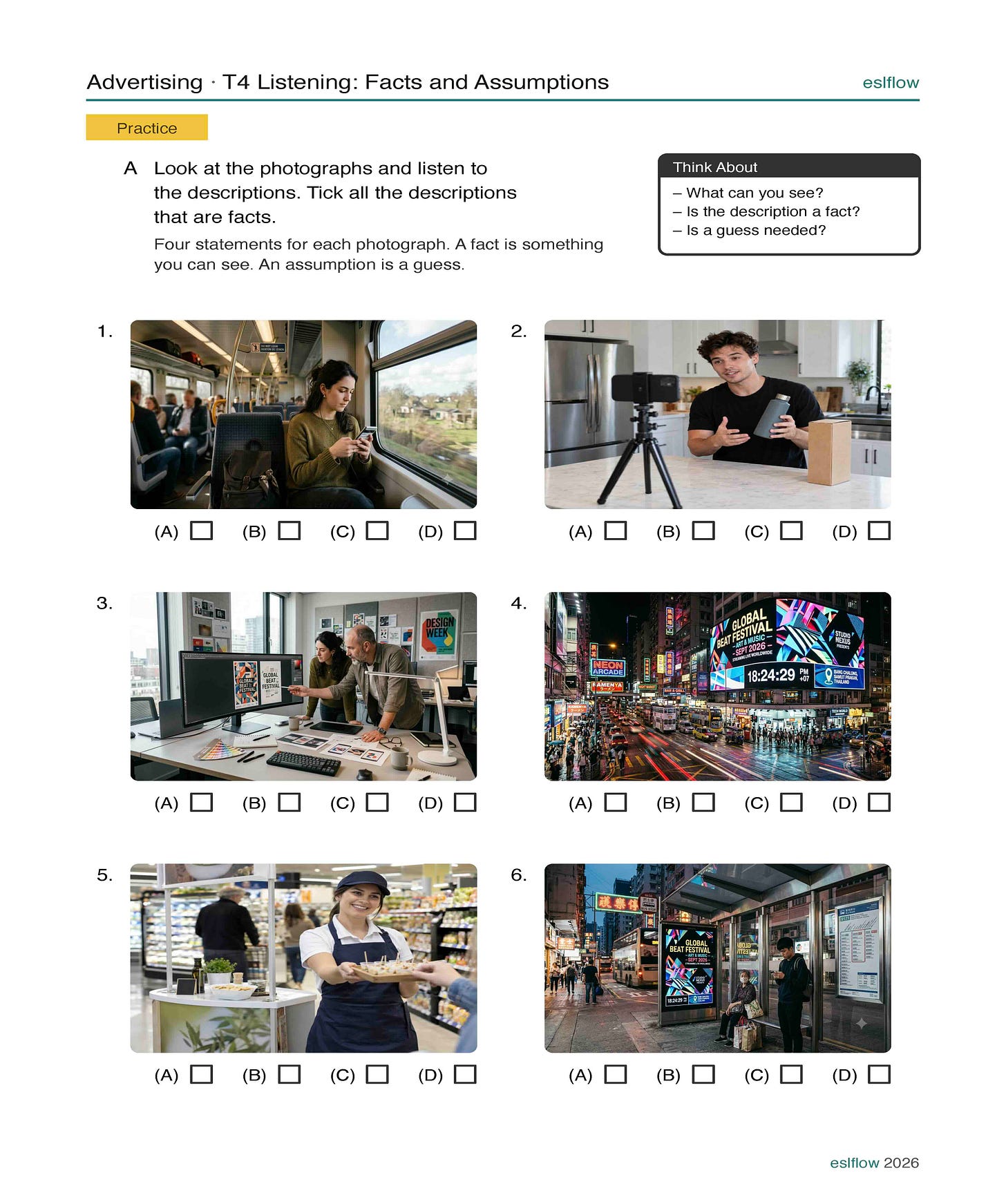
A new lesson format. Most lessons build slowly around one topic. These are different: six steps in a row, each one focusing on a different skill. Picture vocabulary with audio, then a quiz reviewing the words; a grammar task — comparatives, the passive, suffixes, the third conditional; a listening task that asks students to separate fact from assumption, or find eight places on a map; a reading task on the small things tests punish — an extra article, a wrong transition, the formal verb where the informal one is expected; then a seven-part mini-test in the format students will meet in the exam. It is intense. A student who gets through a unit has been tested on vocabulary, grammar, listening and reading in one sitting, and has seen how the four connect. Four units — advertising, customer service, finance, shipping and logistics — pre-intermediate to intermediate. I'm calling them Test Prep Lessons for now, though "language workout" is closer to how they feel in class.
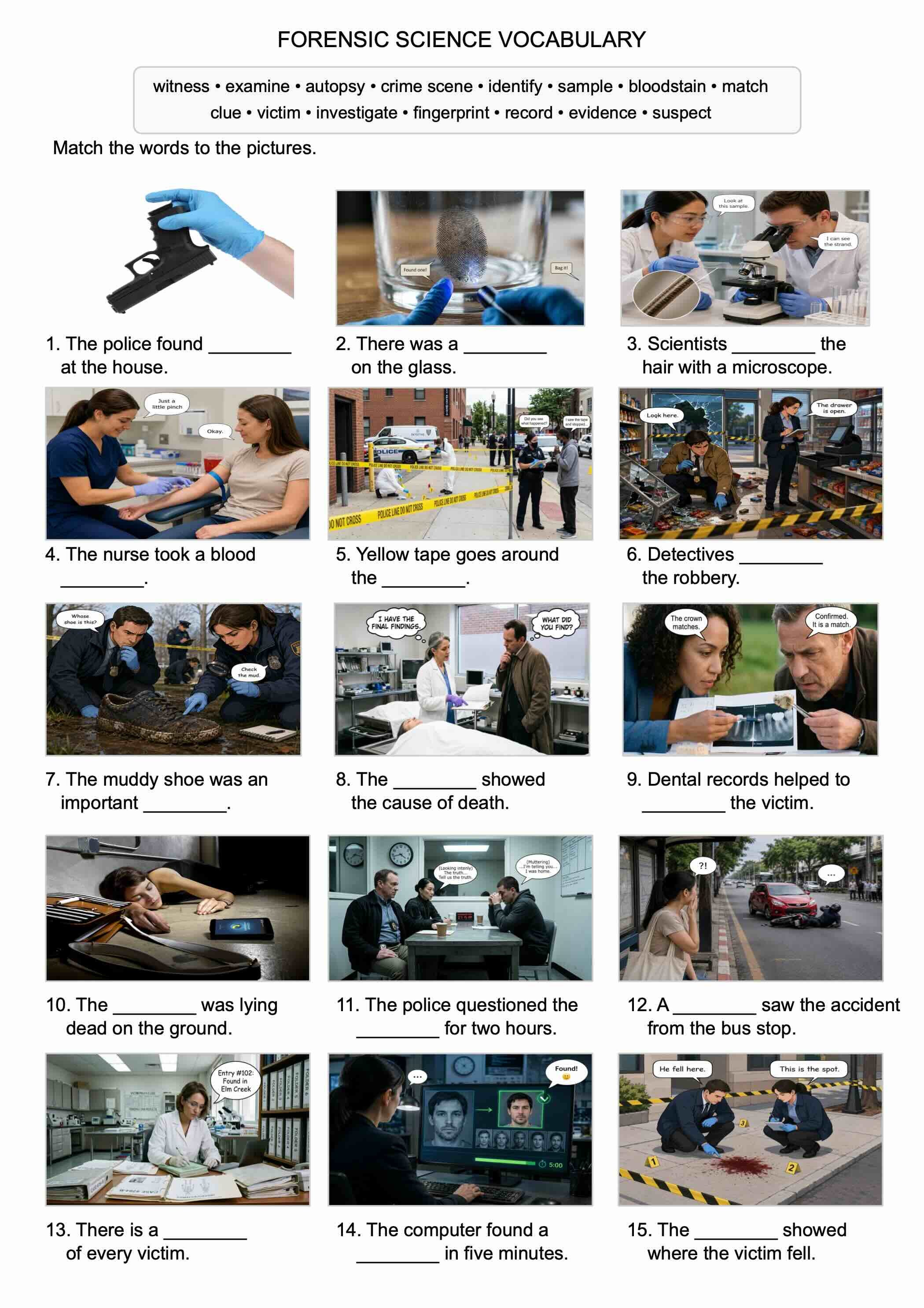
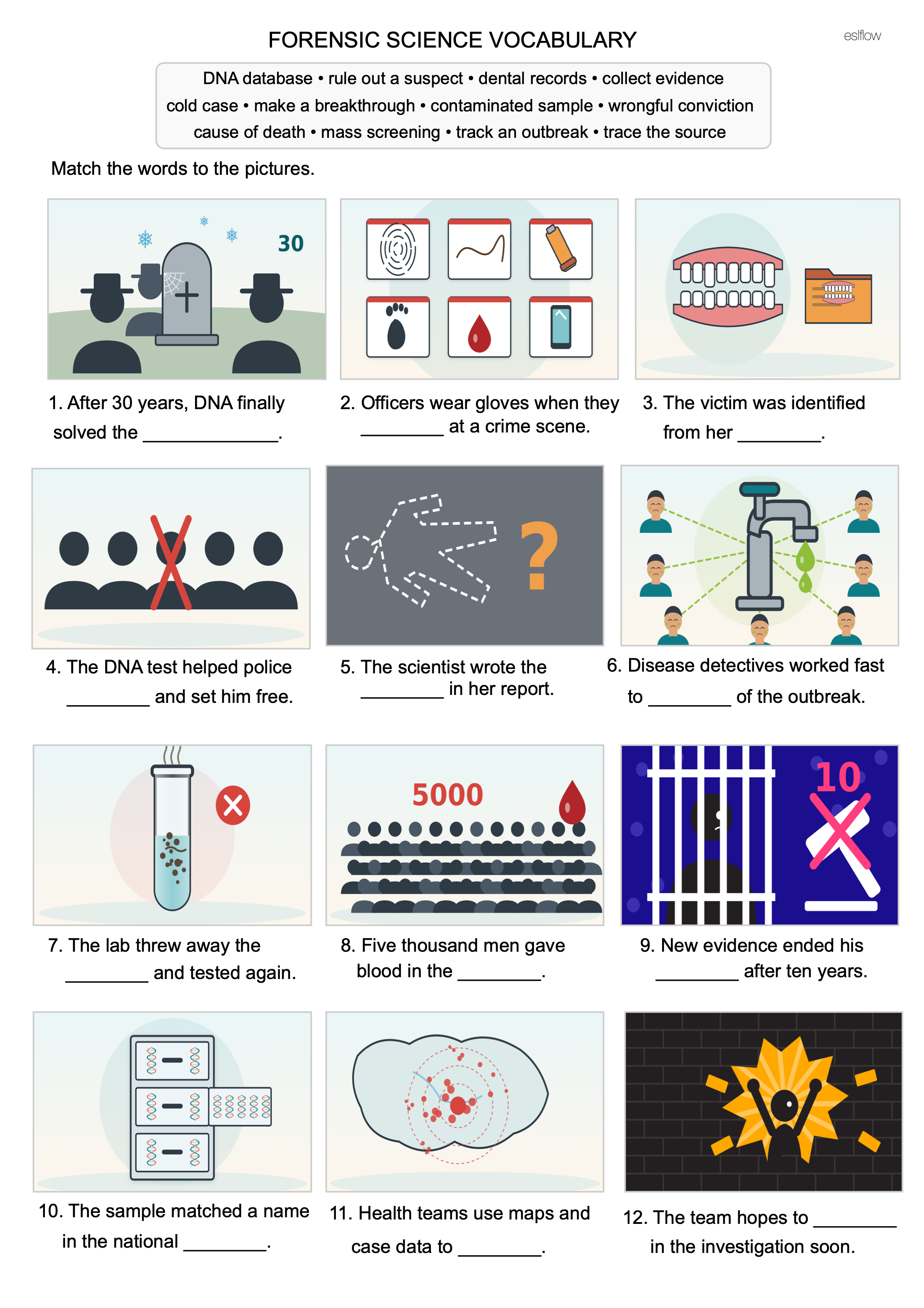
New pictures. Any word or idea can now be illustrated. Concrete words get photo-style scenes with short speech bubbles — a fingerprint on a glass, a nurse taking a blood sample, two detectives over a muddy shoe. The camera can zoom in on a detail or pull back to show the whole scene, so one setting can teach several words. Abstract ones, the phrases that used to be impossible to picture, get a simple symbolic image: cold case is detectives around a tombstone with "30" on it; rule out a suspect is a row of heads with a red cross through one; mass screening is five thousand tiny figures. The target word never appears in the picture or the speech bubbles, so students have to match it.

Forensic Science — Pre-Intermediate
New. Fifteen core words, among them evidence, fingerprint, sample, crime scene, investigate, clue, autopsy, identify, victim, suspect and witness. These are forensic words, but they are also the basic words of the criminal justice system — the ones in every news report, every court case, every police drama — so they are part of everyday life, not specialist vocabulary. The lesson includes the story of the first DNA case , language expansion exercises and a critical thinking page on who can see your DNA. A longer reading, "Naming the Missing", is about the tsunami victim identification operation in Phuket — 3,750 bodies, 300 investigators from 30 countries, and dental records doing more of the work than DNA. It ends in writing: students sort their ideas on a paragraph planner — ways to identify a person, the careful steps, who the science helps — then write a paragraph on how forensic scientists identify a person, with the planner beside them.
Forensic Science — Intermediate
The harder version, expands the vocabulary further with a new set of phrases: cold case, rule out a suspect, dental records, cause of death, trace the source, mass screening, wrongful conviction, contaminated sample, make a breakthrough. The critical thinking pages go deeper too: evidence vs privacy, when science gets it wrong (eyewitness memory and confessions rank lower than students expect), and public health vs individual rights. It finishes the same way — paragraph planner, then a written paragraph.
Medicine 2040 — Your Future in Healthcare (Pre-Intermediate)
New. Healthcare is one of the fastest-growing sources of jobs, and this lesson asks pharmacy and medical science students a direct question: which field do you want to work in? The vocabulary covers telemedicine, genetic testing, forensic science, herbal medicine and the career path. Critical thinking pages on human versus AI, the skills students will need in 2040, and choosing a specialty. The writing task: the career I would choose, why, and what I need to do to be ready.
I taught this one first. When the class got to choosing a specialty, most of them chose forensic science. That is where the Forensic Science lesson came from..
Test Prep Lessons — Four Six-Step Units (Pre-Intermediate to Intermediate)
The new format. Each unit is the same six steps: T1 picture vocabulary with audio, T2 vocabulary quiz, T3 grammar focus, T4 listening, T5 reading, and T6 a four-part mini-test with its own audio. Fifteen words per unit, a binder for students, an answer key with every script for the teacher.
Advertising — billboard, slogan, influencer, endorse, trial offer, followers (the 2026 update replaced circulation, toll-free numbers and classified ads). Grammar: comparatives and superlatives. Listening: facts vs assumptions in photographs.
Customer Service — complaint, compromise, hostile, impatient, under pressure, satisfied customer. Grammar: passive voice. Listening: photo descriptions with sound-alike traps. Reading: transitions.
Finance — balance sheets, recession, fraud, cash flow, volatile, price hikes. Grammar: suffixes across noun, adjective, verb and adverb. Listening: types of talks. Reading: understanding tone.
Shipping and Logistics — cargo, transit, declare, express delivery, tracking number, weight limit. Grammar: third conditional, with the two mistakes everyone makes built into the exercise. Listening: map locations.